


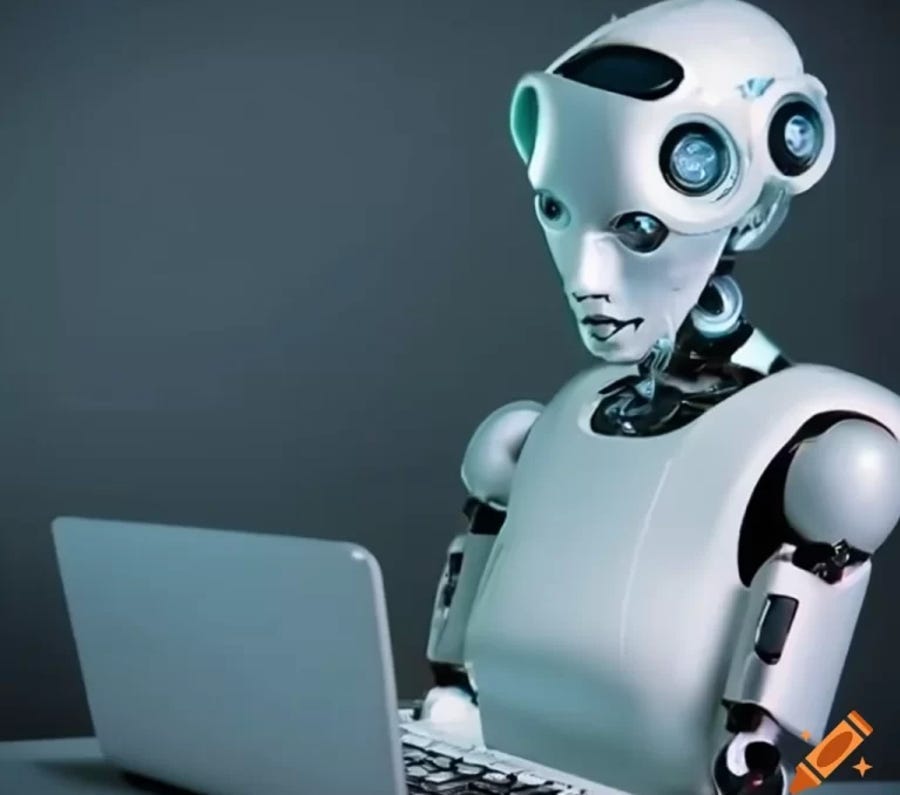
Will AI bots kick us writers to the curb and replace our work? If you aren’t living in a cave, you already have heard that we’re on our way out. Some of that is true, some is kind of distorted, and some is total horse hockey. Let’s sort through it—maybe you’ll feel better. Or not.
What does the US Copyright Office say about copyrights and AI?
The following is a condensation of the recent rules on copyrighting AI-generated intellectual properties (yes, that could change at any moment). You can read the entire directive from the Federal Register, and you should, but we’ve condensed it here.
Background
The US Copyright Office is receiving increasing numbers of copyright registration applications for works containing AI-generated content. Some name AI or an AI platform as the author or co-author, and some say AI-assisted. It should be noted that the vast majority don’t even mention AI generative work in their applications.
So, the Office issued a statement of policy on applying copyright law’s human authorship requirement to such works. The statement provides guidance and acknowledges that AI-generated works implicate other copyright issues that have so far not been addressed. However, the Office has launched an agency-wide initiative to delve into a wide range of these issues (and that includes a series of webinars).
Only humans can be authors
The US Copyright Office (USCO) believes that only works created by humans can be protected by copyright. This is based on statutes and judicial guidance, including a Supreme Court case defining an “author” as a human who originates a work. Federal appellate courts have also concluded that copyright protection is for “works of authorship,” which implies human involvement. Right now, the Office’s policies require that works are the product of human authorship. They will deny registration of works completely produced by any machine or mechanical process.
How does the Copyright Office figure that out?
They evaluate works with human authorship combined with uncopyrightable material (including AI-generated) on a case-by-case basis. If the traditional elements of authorship or creativity were conceived and executed by a machine (and that means AI, of course), the work lacks human authorship. However, (and here’s the prime issue)
…if a human selects or arranges AI-generated material in a sufficiently creative way, or modifies the material to meet the standard for copyright protection, the resulting work may be eligible for copyright protection, but only the human-authored aspects.
We understand that using technological tools in the creative process is allowed as long as a human has creative control over the work’s expression and forms the traditional elements of authorship. We don’t understand how this will be enforced or even determined. Neither does anyone else, so far. It should be noted that the people submitting non-human work are generally not so stating.
Can you apply for a copyright on AI-gen material?
Applicants must disclose AI-generated content in their copyright registration application and provide an explanation of the human’s contribution. This can be done on the normal application form. AI-generated content that is more than de minimis (insignificant in the eyes of the law) is to be left out of the application. If unsure, applicants can provide a general statement about the AI-generated contribution, and the USCO will determine how to proceed.
And that, ladies and gentlemen, is going to create issues. What could possibly go wrong? Of course, EVERYONE will be completely candid, just like the diffuses on Medium and Substack, who pawn off poorly written AI crap as their own work.
If an author previously filed an application but did not disclose AI involvement, they are expected to withdraw the app and amend it. (Right.)
The Office continues to monitor new developments surrounding AI and copyright. They may issue additional guidance. Or not. And what difference will it possibly make?
What I think I think about all of it
The following is what I get from a lawyer’s interpretation of what’s going on, as explained in Copyright Protection for Works Resulting From Some Use of Artificial Intelligence in the United States
As a member of the writing/publishing community, you will want to read the above-captioned article from expert legal minds.
Our take is that most writers, authors, and creators know that the United States Copyright Act provides legal protection for original intellectual properties (IP) fixed in a tangible medium. So what does that mean?
IPs include literary, musical, artistic works, and software, as well as other specified forms of expression. A tangible medium is a physical or digital format that can store creative work like books, CDs, DVDs, digital files, etc. Copyright protection can only be defended in court if you register your copyright. It is not dependent upon a particular storage format but is dependent on the IP’s originality and fixed nature.
Original
We all understand that original implies you thought of the material and created it without copying someone else’s work.
The Supreme Court’s decision in Feist Publications, Inc. v. Rural Telephone Service Co., Inc., 499 U.S. 340 (1991) is the USCO’s citation for interpreting the term original. It apparently says registered work must be “independently created by the author” and have “at least some minimal degree of creativity.” Further, the article we‘ve referenced above says originality and uniqueness are not necessarily the same.
Fixed
Fixed is usually understood to mean the material is perceptible by touch — tangible — and produced in one of the media listed above.
Authorship
And here’s what all the heated discussions are about. We figured out, according to Copyright Code 17 USC § 102, that you can’t register a copyright for “an idea, procedure, process, system, method of operation, concept, principle, or discovery, regardless of the form in which it is described, explained, illustrated, or embodied in such work.”
For example, if you wake up tomorrow and have a scathingly brilliant idea for a novel, great, but you won’t be able to protect that idea with copyright. However, if you write a book about your idea, you can.
Is it human creativity or kind of human or nope, not human?
Work created through a combination of human creativity and technology is not a new concept to the Copyright Office. And they know all AI-generated material is not equal.
They know it’s possible to generate material simply by asking the AI bot to do it. Like this
Prompt Example 1 — “Chat GPT, write a paragraph about horses.”
Then, too, a human can creatively compose a complicated prompt informing and directing the AI’s response.
Prompt Example 2 — “Hey, Chat, write me a paragraph about a five-year-old horse named Tom with a broken leg, and his owner has to decide Tom’s future. Use human reactions, dialog, and options of putting the horse down or finding him a forever home.”
The texts will be entirely different. Try it.
AI-generated content isn’t illegal, but now, the USCO must decide at what point the product is human creativity assisted by a machine rather than non-human creativity. If they decide that AI determined “the expressive elements of its output,” the property is not protectable, and such components must be disclaimed in a copyright application. In the first prompt example, we’re betting on a turndown.
Well, is it registerable? Is it human?
The world is seeing a couple of things right now. Opportunists jump on AI to generate tons of content in minutes, with no regard for quality, to dupe the public, and to make a fortune. Other creators interested in content and technology are experimenting with AI platforms to see what happens if they create careful, robust prompts and then edit and rework the material until it satisfies their creative taste.
Meanwhile, while all this was happening, we attended the Copyright Offices’ panel discussions about AI creativity, which brought hours of debate over what’s fair and what’s not. Those experts who come from the creative side — authors, artists, musicians, etc. — are committed to protecting the rights of creative workers.
Experts who work from other angles — tech companies, legal teams, AI developers, etc. — are all about protecting the rights of technological advancement and the right to make a profit. The USCO is tasked with determining how to satisfy everyone. And that will never happen.
Is AI-generated content illegal?
The USCO’s end decision will be human-generated, and humans are subject to feelings and biases. Can creative properties contain AI-generated material but still represent enough human input and control to deserve copyright protection? That isn’t an objective question.
Much of the creative work you read, bought, and displayed as art over the past half-year may fall into this niche.
It is being suggested that, in these instances, we can register human-generated aspects of our work “independent of” the copyright status of the AI-generated stuff. But I’m asking how much creativity has to be human, and who decides those ratios?
When a prompt is created but not recorded, how in the world does anyone decide its quality? And, most importantly, how is any of this to be proven when the plethora of “AI detectors” out there in cyberspace are, so far, not reliable at detecting? Can the authors be relied upon to fess up?
A lie can travel halfway around the world while the truth is putting on its shoes.” — Mark Twain
What should creative workers do now?
Is AI-generated work going to replace all of human creativity, at least as far as writing and visual art goes? Maybe. Probably.
For now, generating artificial content has brought a bunch of really skeevy actors out of the woodwork to spam every available platform and publication with fast-generated glop posing as “writing.” Many platforms turn a blind eye. Those skeevy “writers” believe they’ve beaten the system.
Crank out garbage and make a bundle for a long time to come. But wait, poseurs! Once you’ve stifled all the human creatives, do you think anyone is going to pay you to keep cranking when they can automate a bot to crank out content without any help from you? Ha!
We’re weary of and somewhat amused by the growing hysteria about AI. First, artificial intelligence is not a new concept or concern. AI technology goes back to the last millennium. You might be amazed how many creatives included AI-generated material in their work before the 2022 AI awareness explosion. So far, nothing is particularly terrifying.
However, that could change at the drop of a new bot.
Humans engaged in creative endeavors should make it a point to understand today’s content realities. Find and follow experts who know the facts. As we saw in the last U.S. Presidential election, crowd hysteria can obscure facts, replacing factual information with bloviated hype. We’re disappointed by how many creatives allow hysteria to move them in a particular direction.
There will be a much saner outcome if we proceed cautiously as an industry or community. If we are armed with facts, not alternative facts, we can ensure our voices are heard while all of this is decided. AI-generated content isn’t illegal, but it does make the definition of creativity meaningful.
I wouldn’t be offended if you click the jar to buy me a nice cuppa green tea. (●'◡'●)

For those who love literature, film, drama, and writing, this is THE nightmare. When I read something, I always want to know that there's a mind a work. AI prompts are all well and good, but AI should be a tool for production and not the end result. Interesting to me that only you and a couple other Stackers are promoting honest conversations about this trend. Of course, there may be several that I am not seeing.
Thanks for this conversation!
I feel displaced, misplaced, and out of place (if not out to space). It is part of human nature to seek the path of least energy expenditure. It is fitting that we shall be the agents of our own replacement.