

Publisher’s Note: Here’s Charlie Fish, fearless leader of FictionOnTheWeb, back with Part 2 of his amazing guide to selling your short stories. Links, samples, secrets, strategies—get reading! This may be the last guide you need to get you down the road to best use of your short stories —or any other creative writing. Charlie Fish’s site, FictionOnTheWeb? Packed to the rafters with his tools to empower short story writers. If you haven’t been over there, read this post, then run, don’t walk to see FictionOnTheWeb! Read Part 2 from Pen2Profit
Part two
Where can you submit?
How many literary magazines and short story markets do you think there are? Have a guess. It might surprise you to learn that there are THOUSANDS.
Here are three great websites that keep track of them all:
• Chill Subs: 3,730 literary magazines, free to use, great community.
• Duotrope: 5,022 fiction markets, paid subscription, great theme and deadline calendar.
• The Submission Grinder: 3,150 fiction and poetry markets, free to use, no-nonsense.
You can also track your own submissions on any of those websites, which really helps if you’re sending a piece to twenty different markets and you need to keep track.
You can go onto these websites and input details about your story, such as the genre and word count, and you’ll get a long list of potential markets. Too long a list – you’ll want to narrow it down. There are a bunch of criteria you might apply to help you filter.
For example, you can filter out all the markets that require a fee to submit. You can filter out the markets that don’t pay. You can look for magazines or themed calls that cover your particular niche. You can look for magazines with a slightly higher acceptance rate, or that are active on social media, or publish a print edition, or where readers comment on the stories that get published.
There’s a big turnover in the world of literary magazines; many of them go defunct and disappear after a few years, so maybe longevity is important to you. You can look for magazines based in your own country. Many magazines take months to respond to submissions, if they respond at all - you can look for magazines that respond within a month, or a week, or a day. If you can work out what’s important to you, these databases will help you target the right markets.
If all that’s too much for you, I’ve got good news. Some poor sucker (me) already scored 3,448 literary magazines against all those criteria and more, and ranked them here: the FISH list of lively independent literary magazines.
If you’re determined to be part of the 4%, if you’re all about prestige, if you want the Granta or New Yorker kind of vibe, I’ve also listed here three well-known rankings of top literary magazines – but note that these have a very heavy bias towards Pushcart Prize winners, and magazines supported by American universities.
You’ll see few non-US projects on these lists, and not many indie passion projects. A lot of the biggest hitters don’t tend to emphasise unsolicited submissions, nevertheless, useful if you want to see the literary state of the art.
Basically, these lists are the tip of the iceberg, but everyone knows the real story is the thousands of quirky independent magazines hiding under the water (which is where the FISH list shines).
• Brecht de Poortere’s Top 1,000+ Literary Magazines

Cover letters? Any writer can compose a good cover letter
Sometimes when you’re submitting a story, you’ll be asked to include a cover letter. The big secret about cover letters is that most of the time, nobody cares. Most of them won’t even get read. So, keep it simple. As an example, which you’re welcome to copy, here’s the last cover letter I wrote when I was submitting one of my own stories:
Dear [Editor],
Thank you for considering my previously unpublished short story "Violet's Breasts” (1,900 words) for publication in The Metaworker Literary Magazine. This is a simultaneous submission; I will withdraw it if accepted elsewhere.
Bio:
Charlie Fish is founder and editor of literary magazine Fiction on the Web. His own short stories have been published internationally, including by the British Library, East of the Web, and Mechanics Institute Review. He can be contacted at charlie@fictionontheweb.co.uk or on Bluesky @charliefish.bsky.social
Thanks,
Charlie Fish
You can address it to “Dear Editor”, but if you check out the website’s masthead you can find the name of the Editor-in-Chief and address it to them by name, which is a nice courtesy.
You should include the story title, an approximate word count, and say if it’s a simultaneous submission or a reprint. I’ve also included a third-person bio, but you don’t need to do that unless the submission guidelines ask for it.
The bio should also be kept simple, you can include two or three previous publication credits if you have them, any formal education you have in creative writing can be useful, or you can just say something like Charlie Fish is a writer of speculative fiction who lives in London, UK with his wife, two daughters, and sentient houseplants. Keep it simple.

What happens after you submit a short story?
Ok, you’ve sent your precious story to a bunch of literary magazines. What happens after you submit? I’m going to take you on a behind-the-scenes tour of Fiction on the Web.
In the first six months of 2025, I got 1,153 submissions. That’s more than six a day, and they average more than 3,000 words. That’s a lot of reading. Together, all those submissions make up as many words as all seven Harry Potter books, plus Lord of the Rings, including The Hobbit, plus War and Peace. TWICE OVER.
I publish two stories per week at Fiction on the Web – or about 10 per month – which works out at just over 6% of submissions. So, remember, if you get rejected, it’s usually not because your story is no good. It’s just maths.
I turn down a lot of good stories for reasons that are nothing to do with the quality of the story – because I’m also managing lots of other considerations in my head, like publishing a balance of genres, lengths and authors, style, or even how far ahead or behind I am with my scheduling. Don’t be discouraged. Keep trying. As an editor myself, I can say from experience that I love it when authors are determined and keep submitting; it feels great for me too when I finally say yes.
While we’re giving away secrets, here’s a two-minute video that gives you a behind-the-scenes look at Fiction on the Web’s sifting and selection process.
I spend an average of two hours a day reading and responding to submissions. Any submissions I accept, I copyedit for grammar and clarity, and I add in HTML formatting so that they will all look consistent when I publish them online.
Next, I go to Blogger, the content management system that I use, and schedule the story. Ever since August 2022, I’ve been using DALL-E and Chat GPT to generate an image for each story, so I go onto there and usually have to create a few different prompts to get an image I like. I take that image and superimpose a quote from the story on it.
I usually have at least a month’s worth of stories scheduled ahead of time. In Mailchimp, I schedule an email and social media posts to announce the story. Once a month or so, I’ll spend extra time writing a newsletter to my Patreon supporters and scheduling extra social media posts to promote my authors.
You see, it takes a lot of work to run a literary magazine, and most editors (myself included) do not get paid! So, as frustrating as it is when your story gets rejected, trust me – editors are on your side.
Most literary magazines are cagey about how many readers they have. Here are some more secrets for you. In the pictured graph, you see that in the last twelve months, Fiction on the Web has had 1,170,000 hits. Nearly half of the visitors were from the USA, about one-fifth from Europe, and the rest from Singapore, Brazil, Chine, Canada, China, India, and everywhere else.
Each story typically gets about two or three thousand people reading it, and between 5 and 20 comments from readers. It makes a big difference if the author promotes the story. Remember at the beginning, when I told you that 96% of the books published by the Big Five publishing houses sell fewer than 1,000 copies? So, each story getting 2,000 reads on Fiction on the Web is not bad.

I thought it might also interest you to see what it costs to run a lit mag. The big ones are supported by universities or wealthy patrons and pay a fortune to solicit famous authors. They pay their editorial staff, and they pay for a bunch of stuff that I don’t. The smallest lit mags may have almost no expenses. This is what it costs Fiction on the Web to run.

On the left is a snapshot from December 2023, showing that it cost me about $375 a month. My bunch of beloved supporters on Patreon pledge a monthly donation – most of them give me three bucks a month – and as of December 2023, those donations were fully covering the cost of the website.
My biggest expense at the time was producing an audiobook each month, professionally performed, recorded, mastered, and edited. I give those audiobooks to my Patreon members as a reward for their support, and the books get published on Audible— a new hour-ish long episode with a different theme every month, featuring some of the best short stories ever published at Fiction on the Web.
My Patreon income grew enough to start paying authors for every story I publish. My goal is to keep growing the Patreon income so I can pay the slush pile readers, too.
My other expenses include fees, domains and hosting, memberships to the Community of Literary Magazines and Presses, Submittable, and Chat GPT for the images. If you fancy becoming a supporter of the literary arts, I will welcome you with open arms. Here’s the Patreon link.
What Else? Money for writers
What about grants, competitions, and writing retreats? Beware of scams – make sure what you’re signing up for is legitimate. FundsforWriters maintains a good list of reputable grants, competitions, and retreats available to writers, focused on the USA, Canada, and the UK. For a UK-only list of grants, try Spread the Word.
New Writers maintains a list of short story competitions. You can run out of money fast paying competition entry fees, and it’s a competitive field, but if you do manage to win something, that carries a lot of kudos, particularly if you are trying to parlay your experience into, for example, finding an agent to represent a novel you’re writing.
Last but not least, here’s a magic link to a whole bunch of wisdom and resources, a spreadsheet of resources collated by Benjamin Davis from The Forever Workshop. The first tab of the spreadsheet contains links to a free 12-lesson course on submitting to literary magazines. It’s an excellent course, I recommend it if you want a deeper dive into some of the things I’ve been talking about. The spreadsheet also has tabs for charts and tools that will help you with submitting, links to external resources, and a list of further reading.
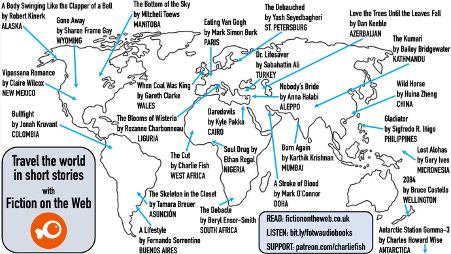
That’s all, folks. I’ll leave you with a promotional graphic I did for Fiction on the Web, which makes the point that you can travel the world by reading short stories. These are all amazing stories that have been published at Fiction on the Web over the years, that will really transport you – especially the one that I wrote, right in the middle there, The Cut by Charlie Fish – as you will have guessed, I’m not above a bit of shameless self-promotion.
On that note, you’ll see links at the bottom for Fiction on the Web, the audiobooks, and for Patreon.
At the beginning of this article, we asked: So you’ve written a short story… now what? Hopefully, I’ve answered that for you and given away a few secrets along the way.