


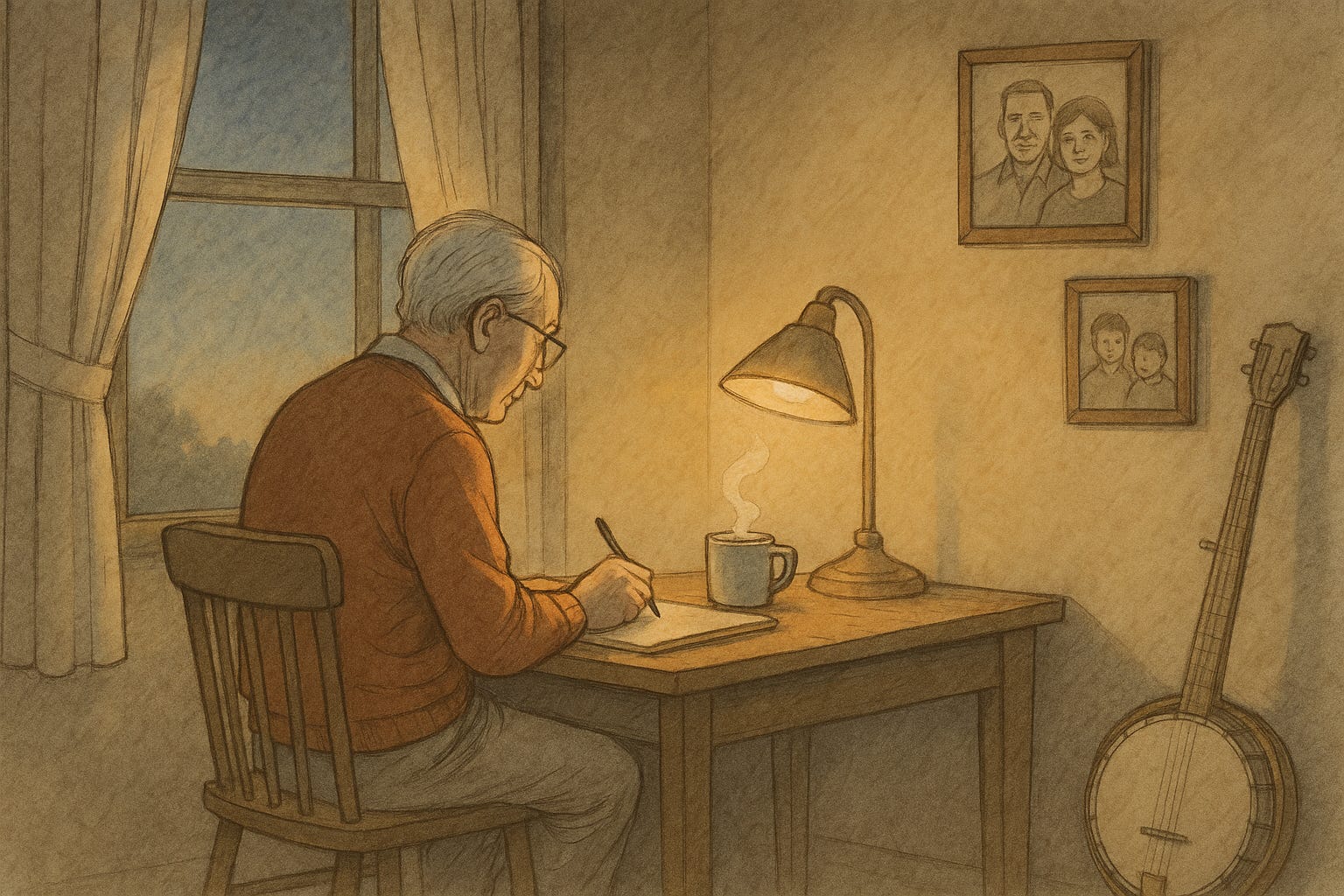
Publisher’s Note: We have had the pleasure of reading great posts from terrific guest writers. Once in a while we get someone who fits our mission and readership to a “T”. That’s my friend Randy. He’s a mature writer, kind of a Renaissance Man with a wide variety of interests. He’s a banjo-playing business expert and writer. You’ll like what he has to say about beginning a viable writing gig as a second career. Here’s Randy.
In 2011, I did something that scared me.
I published a tiny blog post.
It wasn’t profound. It wasn’t polished. And it definitely wasn’t popular. But hitting that button felt like stepping into a spotlight I didn’t ask for. I hovered over “publish” longer than I care to admit, wondering who would ever care what I had to say.
Nobody read it.
But something important happened.
That little post got me started.
And fourteen years later, I’m still writing—and still learning.
Because as it turns out, writing grounds me.
A quick timeline of how I became a writer (without planning to)
1997—Bought Photo Etch Company (business writing)
2010—Sold Photo Etch
2011—Started my blog
2014—Began posting consistently on LinkedIn
June 2021–Late 2022—Completed a full 52-story Storyworth memoir
August 2021—Started publishing on Medium
January 2025—Started writing on Substack
Every stage taught me something different—about writing, business, aging, and myself.
2011: The scary beginning
My whole life, I had been the business guy—numbers, operations, decisions, people. Writing wasn’t part of my identity. So when I built that first blog, it felt unnatural and risky. I remember staring at the screen, thinking:
Who am I to write? What if someone actually reads this? What if they think it’s terrible?
When I finally posted it, nothing happened. No likes. No comments. No feedback.
But I liked the feeling of taking all the swirling ideas in my head and shaping them into something clear. That quiet satisfaction surprised me. And it pulled me back to the keyboard again. That was the first sign that writing might be more than a one-time experiment.
2014: LinkedIn taught me that writing is connection
Three years later, I started sharing thoughts on LinkedIn. Back then, people mostly posted resumes, not personal stories or reflections. But I took a chance. I wrote about manufacturing, leadership, quality systems, and the human side of doing business. Something I didn’t expect happened:
People responded.
Not with likes—with stories of their own. Conversations started. Connections formed.
Before long, the audience grew to 10,000+ followers, many of whom became customers, collaborators, and friends.
That’s when I learned my first big writing truth:
Writing is connection disguised as communication.
The more honest I was, the more others related.
And the more I wrote, the more I realized writing wasn’t just for authors—it was a practical business tool. Writing clearly helped me think clearly. And thinking clearly helped everything else.
After I sold my company, writing shifted from tool to fun
When I sold Photo Etch in 2010, it created a strange gap in my life. I had spent years writing to lead, communicate, and persuade. Suddenly, I didn’t have to write for anyone. No memos. No client letters. No production updates. No cultural mission statements.
For the first time, writing didn’t have a purpose attached to it—and that’s what made me discover its real purpose.
I wasn’t writing to sell anymore. I was writing to understand.
I wrote about aging, purpose, lifelong learning, music, and what it means to keep growing after 60. It helped me organize my thoughts, process the past, and prepare for whatever came next. Writing became a mirror—a quiet way to see myself more clearly.
The year that changed everything: My 52-Story memoir
In June 2021, my daughter gave me a gift that changed my writing life: A Storyworth subscription—one prompt every week for a year, then a printed book at the end.
I wasn’t sure I could do it. It actually took me a year and a half. Writing about business was one thing—writing about my life was another. Some weeks, I struggled for words. Other weeks, I couldn’t type fast enough.
When the finished book arrived in late 2022—with full-color photos—I gave copies to my daughter and two grandsons. They read it cover to cover.
Their reaction stunned me.
They were amazed by the coincidences, unexpected turns, and miracles that brought our family together. They learned things they had never heard before—because, frankly, much of my own family history was barely documented. The emotion hit me harder than I expected.
Finishing that book made me realize:
How little I truly knew about my parents and grandparents
How fast family knowledge disappears
How important it is to leave a record
That project didn’t just deepen my writing habit, it fueled a mission:
Write so your life doesn’t vanish with time.
Write so others can learn from your path.
Write so your grandkids know where they came from.
It didn’t just tell my story; it gave me a reason to keep telling stories.
2021–2025: Medium, Substack, and the slow road to good writing
I started writing on Medium in August 2021 and on Substack in January 2025. Those two platforms taught me patience in a way nothing else had.
My first year on Medium: less than $10 in earnings.
Second year: the same.
Third year: the same.
This year: finally crossing $100+ and growing.
Those numbers might discourage many writers. But to me, they’re proof of something more important:
Writing is a long game—and the payoff isn’t money.
It’s clarity.
It’s expression.
It’s the daily discipline of showing up.
And slowly, sentence by sentence, I am getting better. Not overnight. Not quickly. But consistently.
Writing has taught me:
Patience—good words can’t be rushed.
Humility—most posts won’t go viral (and don’t need to).
Clarity—if I can’t explain it simply, I don’t understand it.
Presence—the best stories hide in everyday moments.
Writing is practice, just like walking or, for me, playing the banjo. You get better by showing up, even when you don’t feel like it.
What writing gives me (that money doesn’t)
Writing has paid me—just not in dollars. It is paying me in:
new friends
unexpected conversations
a growing community
new business opportunities
perspective
purpose
People reach out from everywhere—older learners, musicians, retirees, business owners—all walking their own winding path and grateful someone else is talking about it. Writing has become my favorite way to stay curious, engaged, and feeling alive.
Why I’m still writing today
Fourteen years after that tiny blog post, I still sit down most mornings and type. It is my most guarded time slot, 7:30 a.m. to 9:00 a.m.
I don’t write because I’m obligated.
I write because it keeps me grounded.
It helps me think.
It helps me grow.
It keeps me moving forward.
It connects me with people who care about the same things: aging well, lifelong learning, music, business, and purpose.
Most importantly, as long as I write, I’m still learning. And as long as I’m learning, I still feel alive in ways that matter.
Thinking about writing? Start. Even if you’re acared.
If you’re wondering whether to start writing, do it.
Start scared.
Start unsure.
Start with one paragraph that doesn’t feel good enough.
Your first post might go nowhere.
Your tenth might surprise you.
Your hundredth might change your life.
We live in an incredible time when anyone—at any age—can share their story, teach what they’ve learned, and build a community around honesty and curiosity. You don’t need to be ready. You just need to begin.
What about you?
What started your writing journey—or what’s stopping you from beginning?
Drop a comment below. I read them all.
Randy is semi-retired, having fun, and imparting life stories and life learning. For him, aging well isn’t about changing everything—it’s about caring enough to keep doing the small things that make him feel his best. You will love his homespun wisdom and grounded advice.
You’re missing countless opportunities if you haven’t visited my bookstore. Items from $4.99, and several are FREE. Go get ‘em!

Love this article! I so identify with Randy's thoughts about writing and how it helps us think for ourselves.