


One of the most popular types of writing was, is, and ever shall be nostalgia…memoir stories. They’re fun to write because they are born in you, and you might not even have to do research if your memories are vivid enough. Read this one, focusing on style, techniques, and word use that all call forth the flavors of this era.
Breathe slowly, deeply. Go back in time with me.
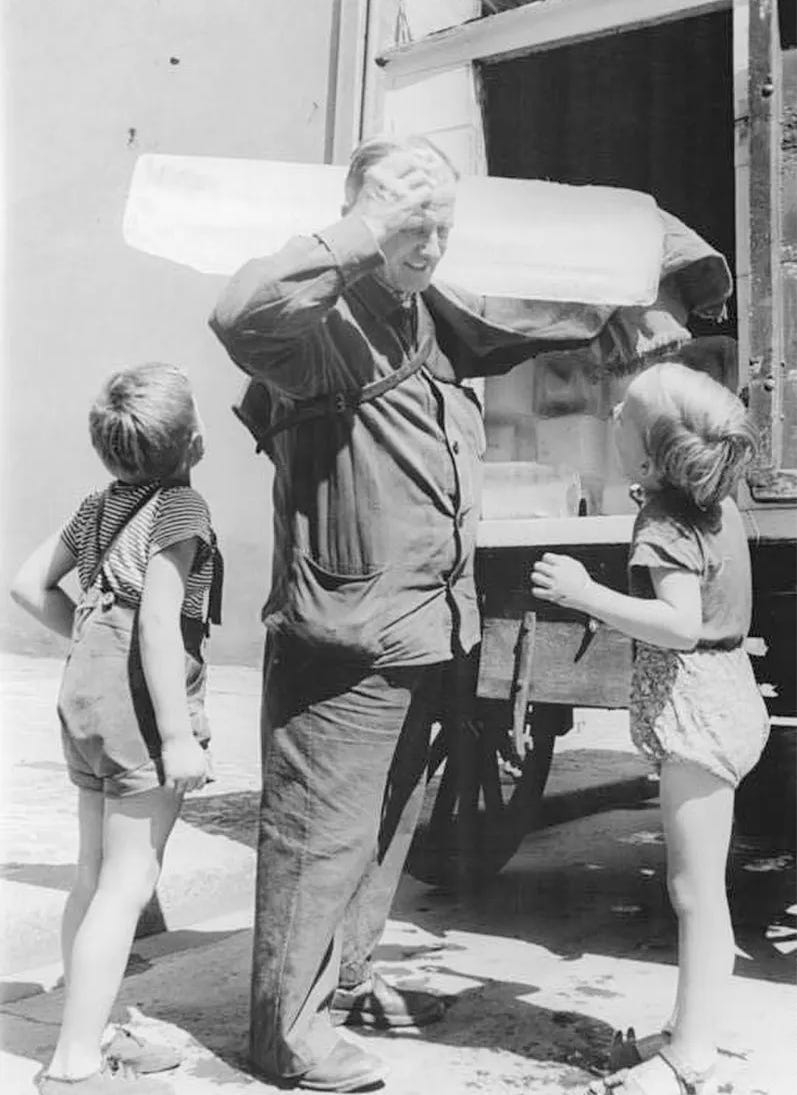
A jump rope makes a rhythmic crack swish against concrete while a pair of little feet in Mary Janes punctuates the rotation with scuffing on the downswings. The jumper’s knee-length plaid dress flares with each double hop. Two more seven-year-olds, stringing the rope across exactly three sidewalk squares, control the cadence as they turn high rotations. Up. Down. In the hot summer stillness, with concentrating faces, the turners recite their lines.
Susie and John-ny sittin’ in a tree
K — I — S S — I — N — G
They keep up the chant until one of three things happens: the jumper misses, the girls tire of counting, or the two boys kicking a ball in the street get bored and chase the girls.
How many kisses did she receive? One. Two. Thr…
And the boys kick the ball into the jumper’s ankles, nearly toppling her onto the sidewalk.
“MOMMMMMMMM!” Her shriek rises to the second-floor window.
Mom sticks her head out and, without a pause, yells, “Jimmy, you leave your sister be,” before she shakes out her dust rag and pops back in.
But Jimmy and his partner in crime effortlessly dodge around the corner of the porch to clatter down the gangway. Their evil laughter, accompanied by the clatter of four heavy shoes, ricochets off bricks and disperses as they disappear into the back alley. They had dumped the jump rope into a plastic wading pool languishing in the punishing backyard sun.
There isn’t a breath of a breeze, and you could wring droplets out of the superheated afternoon air. The girls have forgotten the jump rope. They retire to the porch to languidly bounce a tiny rubber ball on the wooden floor, scoop up pointy metal jacks, and not care much if they miss. They’re waiting for a little shade and maybe a breath of wind. Susie’s nose twitches as the spicy smell of spaghetti gravy wafts down from the second floor of the brownstone two-flat, and she thinks vaguely that spaghetti is the wrong meal for a day like this.
You’re looking at a summer day in 1956. Global warming aside, I swear it was way hotter than now. Without air conditioners, there was no respite. It was hot in the morning. By the time you finished breakfast and hit the neighborhood with your friends, heat mirages shimmered from every paved space. There were no lawns to speak of in the city, just stingy squares of pale grass in front of each two-flat. Maybe a scraggly tree in the parkway, but certainly not a greenbelt.
On this particular day, the midday heat is so oppressive that moms make kids stay in and play quietly on enclosed back porches for an hour or so. Right or wrong, moms declared early afternoon the hottest part of the day. So the kids dutifully engage with comics, paper dolls, and library books — maybe a color book or a couple of hands of War. Mom lets them go around three or four o’clock — they own the sidewalks till supper time. Hot, steamy sidewalks. Kickball, stickball, hopscotch, and red rover.
Kid voices beneath double-hung windows shout for a friend to come out.
“Yo Billll eeeeee.”
Down the block, a push mower shreds anemic grass, a stray cat hisses at a neighbor’s dog, and always, someone yells at someone for something. Later, moms come out to sit on front porches.
Adults didn’t organize group activities or field trips to local attractions. There were no traveling sports teams. Kids did kid stuff, and grown-ups did grown-up stuff, and life ebbed and flowed. Once in a while, some kid would do something to attract parental notice, then doors would slam, mom scolded, and a howl went up as the kid met their comeuppance.
While it doesn’t seem like such a long time ago when I dreamily recall the sounds and smells of that distant day, it was a different world, and you’ll know that if you’re of a certain age. Before long, humans would be landing on the moon, the Beatles would land in America, and all hell would break loose in Vietnam, Selma, the women’s movement, and politics. But for the moment, we lived in a time warp. It was the 20th Century, modern times, but my neighborhood retained some of the trappings of an earlier era.
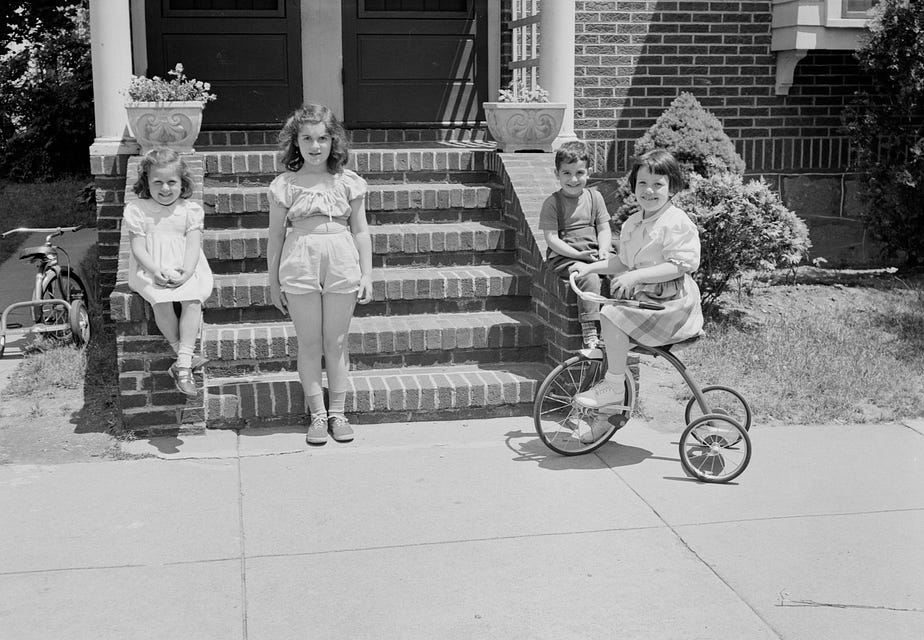
For example, we jump-roping girls might easily have been reprieved on a given day by the coming of the iceman. The clip-clop of horse hooves announced his regular rounds in our Polish neighborhood. He arrived in a pre-war rusty panel truck painted haphazardly in garish yellow with blue block letters on the side. Fresh Ice.
The guy wore a denim shirt with rolled-up sleeves, baggy overalls, and a skull cap of some sort. In the dark, deep back of the truck was a summer miracle stacked over scattered straw. Huge blocks of ice were so clear I swear you could read a newspaper through them. There were stiff, thick purple tarp squares over the rows of ice blocks.
The iceman set one of those tarps over his shoulder when he was about to lift a block and deliver it to some housewife’s front porch. He’d grab a giant set of iron tongs from a hook on the truck wall, clamp them on the ice, and chunk it onto his shoulder, bending a little to deal with the weight.
But the miracle was this. After he did his work, we kids gathered around his truck and stood silent and still, just waiting. No one clamoured or wheedled, we just stood. In no hurry, he would take out his sharp, glittery icepick, wipe it on his apron, and chink it into a block. When he had the same number of chunks as there were children waiting, he’d grin and hand them around, cupping each piece in a small tuft of straw. Each kid said thank you, sat on the curb, and slurped and licked that crystal as if it were the finest Häagen-Dazs®.
The Iceman was the absolute rock star of those hot summer days. Until the early 1960s or so in the U.S., ice was cut into blocks of up to 100-pound blocks and then distributed by wagons. Enough households still used ice boxes, not refrigerators, that could be had for under $50. My aunt, who lived below our flat, had an ice box with hollow walls lined in zinc and insulated with dried seaweed. As a perk, I enjoyed summer popularity since the iceman always came to our house.

Other peddlers often called their wares on my block. Fruit peddlers in rickety trucks. The knife-sharpening guy with his grinding wheel rigged up to a modded bicycle. An old man with a colorful, slatted pony wagon in which, for a nickel, you could catch a ride around the block. The sound of the horse and the jiggle of the ride was like an exotic vacation, even though the earthy odor of equine sweat was a bit much in the heat.
Maybe once a month, the ragman cometh. His conveyance was a rugged wooden pushcart with a large wheel in front and two metal triangle brackets at the back to balance the cart when it stopped. My ears pricked up when he hit the end of our block, roaring in a deep, massive baritone, “Rags-align! Rags-align!”
It was many years before I learned that his call was really “Rags, old iron,” since he bought and sold old clothes and old metal.
Interestingly, Oscar-winner Kirk Douglas talks in his autobiography about his father, a ragman.
“My father, who had been a horse trader in Russia, got himself a horse and a small wagon, and became a ragman, buying old rags, pieces of metal, and junk for pennies, nickels, and dimes … Even on Eagle Street, in the poorest section of town, where all the families were struggling, the ragman was on the lowest rung on the ladder. And I was the ragman’s son.”
Street trades are a critical part of city histories, and they gave rise to a number of permanent businesses, restaurants, and retailers. In simpler times with fewer regulations and ordinances, men and women who added to the color of our childhood peddled food items, farm produce, flowers, scrap paper, rags, and iron. They sold services like repairs and home improvements. The most colorful street peddlers were the musicians, and my city, Chicago, is noted for its blues traditions among street musicians. You still find these guys in the corridors at O’Hare Airport.
1950s city life was neighborhood-centered. Back in the 19th Century, when immigrants created our city cultures, people tended to settle in homogenous communities. In Chicago, thriving, thronging Italian, Polish, and Swedish neighborhoods fueled the melting pot.
Each neighborhood likely had its own tiny grocery store with rough-sawn wood floors. There was always a candy store; ours was a combo candy store, post office, ice cream parlor, and book-making center. Joe-the-bookie, the only thing anyone ever called him, owned it for his entire lifetime.
If I sit quietly now, I hear the squeak-slam of his wooden screen door and footsteps across the floor planks. The air inside carries waves of post-office machine smells, strong coffee, and people smells. I hear Joe yelling into the coil-corded telephone about some race, and someone better pay up.
There’s a whole landscape of shelves heavy with wares like a cuckoo clock with ornate trim, molded metal cars and trucks, and a row of apothecary jars containing unwrapped sticks of candy. A glass-fronted wooden display case that seemed a mile long runs the length of the store. It offers bullseyes, Twizzlers, button candy, Mary Janes, Bonomo taffy, Topp’s baseball card gum, wax bottles filled with sugary colored water, and a hundred other delights.
Those jump-roping girls are grandmas now. The little kids in their lives know supermarkets, Amazon, expensive organized activities, and pixels on screens. The games they play on hot summer days are probably electronic. I’ll admit the good old days had their challenges and issues, but looking back, they’re sure a sweet remembrance.
If you’re serious about powering up your writing revenue, I have two excellent tools for you. First, take advantage of a current deep discount on annual subscriptions to Pen2Profit. Do it now—time is running out!
Or dive deeper and sign up for the about-to-launch Write-Earn-Repeat course at 50% off tuition.
"You still find these guys in the corridors at O’Hare Airport."
And when I was living there, the subway. I don't know if they are still around there.
Wow Miss Pelland. I didnt know you could write like that